


Article
Art by Marco Guadalup

Thomas Turner Saves the Day

Will Thomas be brave enough to step in when it matters most?

By Deborah Hopkinson
From the May/June 2026 Issue

Learning Objective: Students will read a fiction story and analyze its protagonist.

Lexile: 400L-500L
Featured Skill: Character

Standards

THINK & READ

As you read, think about what’s important to Thomas.

London, England

September 1599

You want me to go up there, sir?” I gulped. “On that ladder?”

I stared up at the high wooden ceiling of the Globe. London’s magnificent new theater would open its doors in two days—and it wasn’t ready! 

I knew I should feel lucky to be part of the team of workers tasked with finishing the theater. There was just one problem. I didn’t like being a carpenter. Not at all. 

I didn’t care about sawing wood, making floorboards, or applying coats of paint. I didn’t want to build a stage; I wanted to be onstage. I dreamed of being an actor.

“Yes, that ladder, Thomas Turner!” ordered my boss, head carpenter Peter Street. “Paint that arch! Everything must be perfect.” 

He was right. We knew that more than 3,000 people would come to the opening of the play. Everyone was excited to see A Midsummer Night’s Dream, a wonderful comedy by William Shakespeare. He was an actor, the greatest playwright of all time—and my hero. 

I loved the play—a lot. I’d been eavesdropping on rehearsals for days. I knew every line by heart.

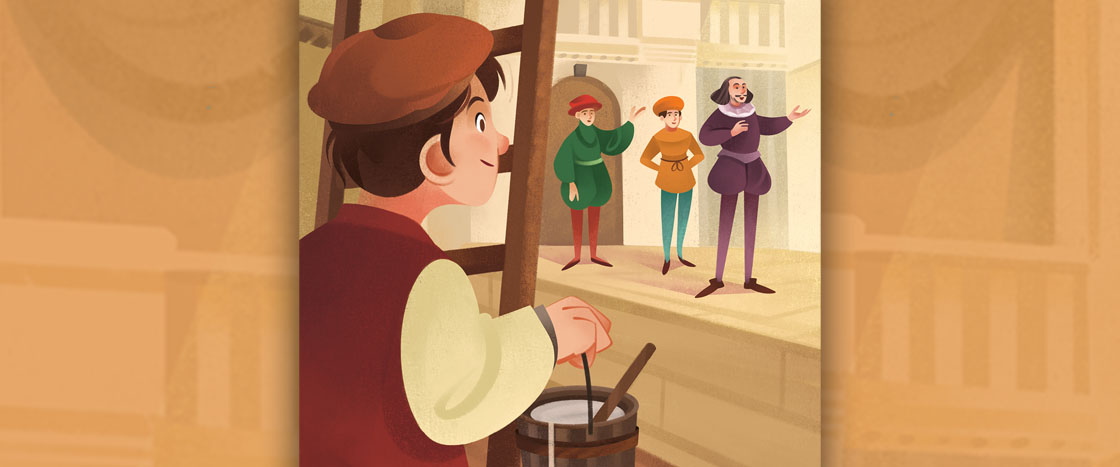
Now, as the actors began practicing their lines, I perched on the ladder. I paused to watch Scene I, holding my breath. At that moment, Shakespeare himself walked onstage. He was a dark-haired man with a short beard. A gold earring gleamed in his left ear. 

I leaned over to see better and then—

CRASH! 

I tumbled off the ladder, landing right in the middle of the stage. Paint splattered everywhere, even onto Shakespeare’s shoes!

My boss stormed over, his face scrunched in anger. “Thomas, get out! I’d fire you now if I didn’t need every hand to finish this theater.” 

Without thinking twice, I fled.

A Terrible Mistake

My steps dragged as I made my way home. Usually, I couldn’t resist tasty treats from the street sellers: gingerbread, baked potatoes, meat pies. Not today. London bustled around me, but I felt completely alone. 

Then I ran into my friend Emma. Her father worked with Shakespeare, so she came to the theater most days. Like me, Emma was 11 and loved to read. 

“Are you done with work already?” Emma asked. 

“I made a terrible mistake,” I began. I told her what happened.

“I know being a carpenter like your father isn’t your dream,” Emma said gently.

I was the oldest of five siblings. My parents needed my help to support the family. Father had begun teaching me to cut, measure, and hammer as soon as I was old enough to hold a tool. 

Or at least, he had tried! I was a complete disaster.

“I try to focus on my work,” I said. “But when I hear the actors, I just fall in love with the story.” 

And today I fell onto the stage itself!

“Peter Street admires your father,” Emma said. “I’m sure he’ll forgive you.”

But would he? What if my boss fired me? What would Mother and Father do then?

A Spark of Pride

At the Globe the next morning, I found the head carpenter and mumbled an apology. 

“One more chance, Thomas, for your father’s sake,” Peter Street said. 

I worked for a while. Then I heard raised voices on the stage. William Shakespeare was trying to calm an argument. 

Emma appeared beside me. “Edward, the boy who plays Puck the fairy, keeps forgetting his lines,” she whispered. “He’s terrible!” 

I watched as the playwright tried to smooth things over. “Now, friends,” said Shakespeare, “remember we must work together to dazzle Queen Elizabeth.”

I couldn’t believe my ears! The queen of England—our ruler, the most important person in the whole country—was coming to the Globe’s opening tomorrow.

“What an honor! Can this be true?” I asked Emma. 

 “Aye,” she replied. “And what the queen thinks matters—a lot.”

One of the actors was now shouting at Edward, “Learn your lines!”

The actor pointed at me. “That carpenter’s lad knows the play better than you. I’ve seen him mouth every word at rehearsals.”

Edward glanced at me, annoyed. But I felt a spark of pride.

The Queen Arrives

 It was opening day! The play would start at 2 o’clock.  

Head carpenter Peter Street repeated a list of tasks. “The queen expects perfection!”

I worked hard all morning, trying to contain my excitement. Soon it was almost time for the play to begin.

“Thomas!” Peter Street called, handing me a broom. “Quickly, sweep backstage—and no daydreaming! Remember, it’s your last chance.”

The actors had gathered backstage. Except Edward. The actor playing Puck
was nowhere to be seen. Someone said he was sick. Another said he had quit in frustration. William Shakespeare paced back and forth nervously.

Everything was falling apart. 

I spotted Emma and told her the problem.

“Without Puck, there is no play,” Emma said. “It will be a disaster!”

Then she stared at me. “Thomas . . . you could do it.”

“Me?”

“You could play Puck.”

I shook my head. “Oh, I can’t.”

“You know the whole play by heart.”

“But Emma, if I leave my tasks, I’ll . . . I’ll lose my job. And I’m not an actor.”

“Thomas, the queen is coming. The future of the Globe depends on you,” she said. “Believe in yourself. I do.”

I glanced at Shakespeare’s worried face. I thought of all his hard work, all his beautiful words.

I set down my broom and crossed the stage. “Master Shakespeare?” I took a deep breath. “I think . . . I could stand in for Edward.”

Shakespeare raised his eyebrows. “Aren’t you the carpenter’s lad?”

“Aye, I’m Thomas Turner. But, sir, I know the play.”

His dark, intelligent eyes were fixed on me. “All right, Thomas, answer this: When
does Puck give the love potion to the wrong man?”

“Act 2, Scene 2!” I told him. “But Puck reverses the potion in Act 3, Scene 3.”

“Very good,” said Shakespeare. “Now, who gives the closing speech?”

“Puck!” I bowed with a flourish and recited, “And so good night unto you all.” 

The playwright nodded. A small smile flitted across his face. 

A noisy, excited crowd began to stream into the theater. A trumpet blared. The queen had arrived!

“Take your place, lad,” Shakespeare said. “It’s up to you.”

The Next Act

“It was wonderful!” I told Mother when I came home that evening. 

“You were onstage?” she marveled. “With Queen Elizabeth watching?”

“Aye. Master Shakespeare said I saved the day. The queen was delighted.”

Just then, we heard a sharp knock at the door. We looked at each other, startled.

My mother opened the door. Head carpenter Peter Street stood on the doorstep. But why was William Shakespeare with him?

 When Street introduced Shakespeare, my mother made a deep curtsy. “I’ve heard much about you, sir. Thomas says you’re a genius.”

Shakespeare winked at me. “Thomas is a bright lad.”

“Indeed, though he’ll never be a carpenter,” my boss declared.

Oh no! 

The carpenter chuckled. “Cheer up, lad. We’ve come with a proposal.”

“A proposal?” asked my mother.

“After today’s success, the Globe will be the busiest theater in London,” Shakespeare announced. “We need another actor. We can train you.”

“Me? You want me?” I looked at the two men in a daze.

“You have a gift,” Shakespeare said simply. “So, Thomas, will you join us?”

My heart soared. I could follow this path with all my heart. 

“Aye, sir. I will!” 

“Then be there at 11 sharp tomorrow morning,” said Shakespeare. 

 As the two men left, I hugged my mother and whooped for joy. I couldn’t wait for my next act to begin.

Think & Write

Imagine you are Thomas. Write a journal entry explaining how you became an actor at the Globe Theater. Use details from the story in your writing. 

This article was originally published in the May/June 2026 issue.

Audio ()
Activities (5)
Quizzes (1)
Answer Key (1)
Audio ()
Activities (5) Download All Activities
Quizzes (1)
Answer Key (1)
Text-to-Speech