*Historians 1, 2 (H1, H2)
*Narrators 1, 2, 3 (N1, N2, N3)
Gus, a barber
*#Bessie Coleman
*#Robert Abbott, a newspaper owner
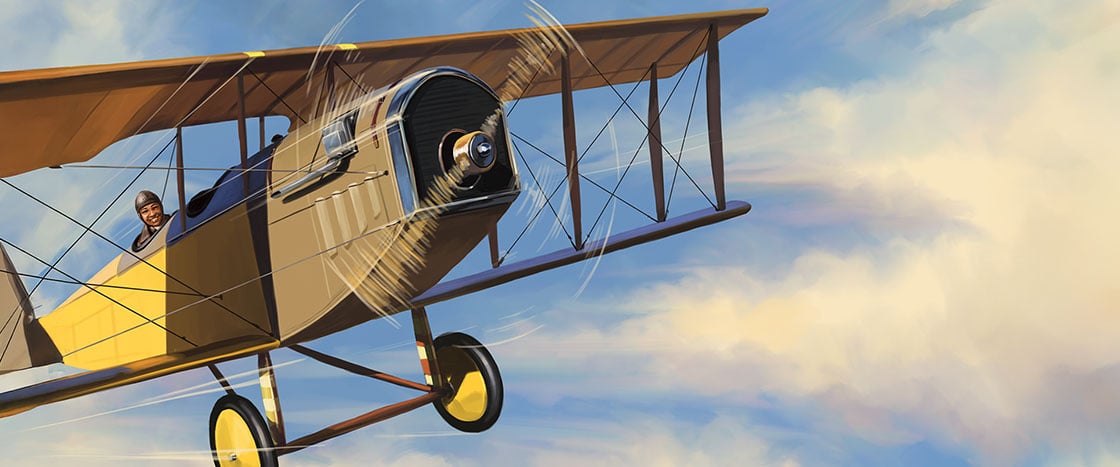
The amazing story of Bessie Coleman, America’s first Black and Native American female pilot
Inspired by true events
Learning Objective: Students will identify the main ideas and supporting details in a play based on the life of Bessie Coleman.


Prologue
George Rinhart/Corbis via Getty Images
Bessie Coleman
H1: Let’s travel back in time to 1892.
H2: Back then, there were no computers. No cell phones.
H1: There were not even airplanes flying across the sky.
H2: It was into this world that Bessie Coleman was born.
H1: Life in Texas wasn’t easy for her and her family.
H2: Bessie’s parents were both Black.
H1: Her father was also part Native American.
H2: Black people at the time were treated unfairly.
H1: Southern states had racist laws that kept Black people separate from White people.
H2: Many neighborhoods, schools, and jobs were for Whites only.
H1: Bessie and her family worked long hours in the fields, picking cotton by hand.
H2: But Bessie dreamed of a different life.
Scene 1
Chicago, Illinois, 1918
N1: Bessie has left the South and moved to Chicago. She’s now 26 and works at a barbershop.
N2: Gus, the barber, is reading the newspaper.
Gus: Look at these new airplanes. It says here they can go more than 100 miles an hour!
H1: Back then, aviation was new and exciting.
H2: The first successful flight with an engine-powered plane had happened just 15 years earlier, in 1903.
Bessie Coleman: Imagine soaring through the air like that!
Gus: I’d rather keep my feet on the ground, thank you.
Bessie: Not me. I’ve always wanted to fly an airplane.
Gus: Achieving that dream would be an uphill battle, Bessie.
H1: At the time, flight schools in America didn’t train women to fly.
H2: But Bessie wasn’t going to let this stop her.
Bessie: Just watch me!
Scene 2
Chicago, Illinois, 1919
N3: Bessie walks into the office of Robert Abbott. He owns a famous newspaper called The Chicago Defender.
N1: It made him one of the first Black millionaires in America.
Bessie: Mr. Abbott, I hear you give good advice.
Robert Abbott: How can I help?
Bessie: I want to be a pilot. But every flight school I’ve tried to sign up for won’t let me in.
Robert: That’s a tough dream.
Bessie: I just need someone to give me a chance!
N2: Robert rubs his chin.
Robert: I think there might be a flight school in France that will take you.
Bessie: All the way in Europe? I can’t afford that.
Robert: What if I helped you pay for it?
Bessie: What? You would do that for me?
Robert: Of course! And when you start flying, my newspaper will write about the first Black female pilot. Your story will sure sell a lot of papers!
Scene 3
Northern France, 1921
Fédération Aéronautique Internationale/Smithsonian National Air and Space Museum via Wikipedia
Bessie Coleman’s pilot’s license.
N3: Bessie works hard and saves every penny she earns.
N1: With Robert’s help, she buys a ticket to sail on a huge ship.
N2: It takes her more than 3,000 miles across the ocean to France.
N3: While she’s learning to fly, Bessie writes letters to Robert about her experience.
Bessie (writing): Dear Mr. Abbott, every day I walk 9 miles to flight school.
Robert (reading): My teacher says I’m a natural.
Bessie (writing): I had my first solo flight today. It was a thrill!
Robert (reading): I did it! I got my pilot’s license. Coming home soon!
Pictorial Press Ltd/Alamy Stock Photo
FLYING HIGH
Bessie got her pilot’s license in 1921. Back then, flying was extremely dangerous. Many airplanes didn’t have roofs, steering wheels, or brakes.
Scene 4
Near Dallas, Texas, 1925
N1: Bessie has become famous for performing in flying circuses.
N2: These are air shows where pilots called barnstormers do dangerous tricks.
N3: Some plunge their airplane toward the ground.
N1: Others climb out on the wings of their plane while flying.
N2: One day, Bessie tours the airfield where her next show will be.
N3: She sees a sign on the entrance gate that says “Whites only.”
N1: It means Black people have to enter the airfield through a different gate.
N2: Bessie is outraged.
Bessie: I will not perform unless every spectator enters the same way.
Tour Guide: But we’ve sold thousands of tickets already!
Bessie: Then you’d best treat everyone equally.
Tour Guide: As you wish, miss.
N3: The tour guide takes down the sign.
N1: The next day, everyone walks through the same gate.
N2: A huge crowd cheers as Bessie flies over their heads.
N3: Fans are amazed by her stunts.
Fan 1: Wow! She’s doing a figure eight!
Fan 2: And a loop-the-loop!
N1: Another pilot takes the controls as Bessie climbs onto the wing.
N2: She stands and waves at the crowd. Then she jumps!
Crowd (screaming): Ahhhhhh!
N3: Bessie pulls a cord and her parachute opens.
N1: She floats down right into the middle of the crowd.
Crowd: Woo-hoo! Brave Bessie! Queen Bessie!
Black Film Center Archive/Indiana University, Bloomington (Flyer); Science History Images/Alamy Stock Photo (Barnstormer)
POPULAR SHOWS
Pilots like Bessie, called barnstormers, performed all types of dangerous tricks at air shows. The flyer below announced one of Bessie’s shows in Ohio. (An aviatrix is a female airplane pilot.)
Above: A barnstormer hangs upside down outside of a plane!
Scene 5
Jacksonville, Florida, 1926
N2: Bessie visits an elementary school for Black students.
N3: She tells them how she became a pilot.
Bessie: People kept telling me no, but I didn’t give up.
N1: A girl raises her hand.
Marian: Miss Coleman, could I learn to fly?
Bessie: I’m raising money to open a flight school for Black women so you can have that chance.
Marian: Really?
Bessie: You are the hope of the future.
N2: Bessie looks at all the children.
Bessie: I want you to dream—and dream big!
N3: As Bessie leaves, a shy girl hands her a folded note.
Ruby (whispering): This is for you, Miss Coleman.
Bessie: What’s your name?
Ruby: Ruby.
Bessie: Thank you, Ruby. I’m excited to read this!
N1: Bessie tucks the note inside the pocket of her jacket.
N2: Later that day, she sees her old friend Robert Abbott.
Bessie: Are you coming to see my air show?
Robert: You bet!
Bessie: After this, I will focus on opening my flight school.
Robert: That’s wonderful news!
N3: As Bessie climbs into her plane, she hands Robert the folded note from Ruby.
Bessie: Will you keep this safe for me? It’s a very important note.
Scene 6
Chicago, Illinois, 10 years later
Smith Collection/Gado/Getty Images (Willa Brown); NASA (Mae Jemison)
INSPIRING OTHERS
Pilot Willa Brown (right) and astronaut Mae Jemison (left) were both inspired by Bessie to pursue jobs in aviation and spaceflight. Jemison carried Bessie’s picture in her pocket on her first trip to space.
H1: Sadly, Bessie didn’t live long enough to open her flight school.
H2: But her life continued to inspire future pilots.
N1: A woman in a flying uniform walks into The Chicago Defender newsroom.
Robert: Excuse me . . . who are you?
Willa Brown: Good morning, Mr. Abbott. My name is Willa Brown. I became a pilot because of Bessie Coleman.
N2: Robert looks at her in awe.
Robert: Well, isn’t that something. Congratulations, Miss Brown.
Willa: I came here to tell you that I’m starting a flying school for Black men and women in Bessie’s honor.
Robert (quietly): That was Bessie’s dream. If only the two of you could have met.
Willa: Meeting her was a dream of mine.
N3: The two pause. They have tears in their eyes.
Willa: A group of us pilots are going to fly over her grave and drop flowers. I thought you might like to know.
Robert: That’s very kind of you, miss. Thank you.
N1: Robert reaches into his desk and pulls out a yellowed, folded note.
Robert: Before you go, Miss Brown, I think I know just the young lady to be your first student.
N2: Willa opens the note as she leaves the newsroom.
N3: It’s from a little girl named Ruby.
Willa (reading): “Dear Miss Coleman, you are brave. I want to be a pilot like you. You made me believe I can.”
Epilogue
H1: Today Bessie is remembered as a trailblazer.
H2: As the world’s first Black and Native American female pilot, she made history.
H1: Her bravery helped other people achieve their dreams.
H2: Like Willa Brown, the first Black woman to earn a pilot’s license in the United States.
H1: And Mae Jemison, the first Black woman to travel to space.
Bessie: Anything is possible if you dare to dream.
Write Now
Why is Bessie Coleman remembered as a trailblazer? Answer in a paragraph, using details from the text. Make sure to explain how her actions helped others succeed.
This story was originally published in the February 2026 issue.