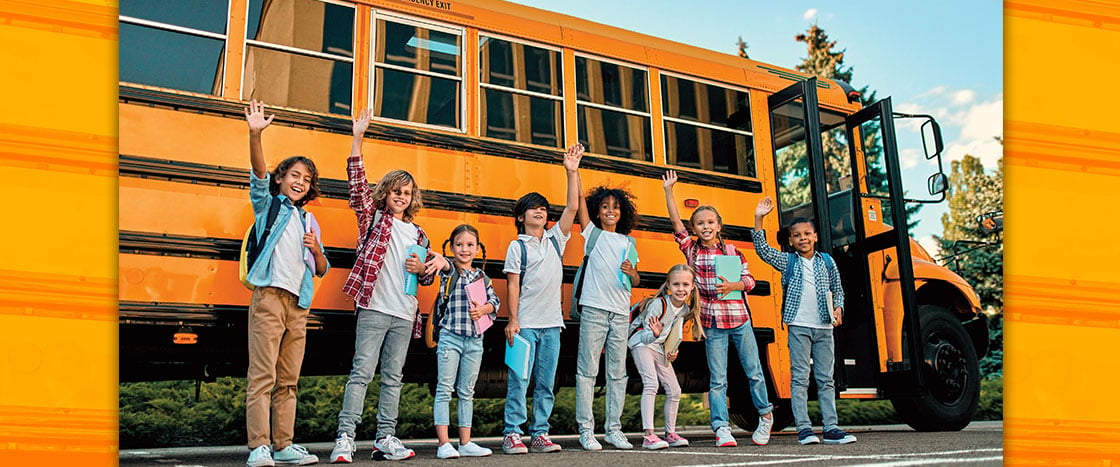
A group of children with backpacks and notebooks wave in front of a yellow school bus
Shutterstock.com

The History of the School Bus

The fascinating story of how kids have been riding to school

By Blair Rainsford and Alessandra Potenza
From the September 2026 Issue

Learning Objective: Students will explain the relationship between events in a text using language that pertains to time, sequence, and cause/effect.

Lexiles: 600L-700L

Standards

Beep beep! 

A long, bright-yellow bus stops in front of your house. The doors swing open. You run up the steps and find a seat next to a friend. As the bus rumbles on, you sit back and start chatting. You’re on your way to school!

Millions of kids in America ride the school bus every morning. But it wasn’t always so easy for kids to get to school.

Wooden Wagons

In the 1800s, students walked to school if they lived nearby. If they didn’t, many didn’t go to school at all. 

But then, states in the U.S. started passing laws that required kids to attend school. So schools had to find a way to get them there. They began sending wooden wagons to pick kids up from their houses.

These wagons, called “kid hacks,” were pulled by horses. Students sat on hard wooden benches. There were no glass windows to protect the kids from wind, rain, or snow. And most roads were unpaved, so the wagons jolted all the way to school. (One mom complained to a newspaper that all the bouncing upset her daughter’s stomach so much that she couldn’t eat her dinners!)

Still, the kid hacks got the job done. They were America’s first school buses.

From the Collections of The Henry Ford. Gift of Albert L. Luce, Jr.

The oldest surviving school bus in America, from 1927, is at a museum in Michigan.

Safer Buses

In the early 1900s, school buses with engines were invented. They still looked like wooden wagons, but they didn’t need horses to pull them. Later, wood was replaced with a much stronger material—a metal called steel. 

All these changes made school buses faster and safer to ride than the kid hacks.

The best part? Big rubber tires were now used instead of thin wagon wheels. This made the rides smoother. The buses didn’t bounce around so much!

School Buses Today

Many early school buses were painted bright yellow. But it wasn’t until 1939 that the color was officially recommended for all school buses. 

Yellow was easy for people to see. That was safer for other drivers—and for the kids riding on the bus!

Today, almost 90 years later, school buses are still bright yellow. But they’ve come a long way since the first school buses hit the road.

Aren’t you glad you don’t have to bounce around in a kid hack?

School Bus Timeline

BARKER AND FAULCONER FAYETTE COUNTY PUBLIC EDUCATION PHOTOGRAPHS COLLECTION, UNIVERSITY ARCHIVES, UNIVERSITY OF KENTUCKY, SPECIAL COLLECTIONS

1800s: Wooden kid hacks pulled by horses

WISCONSIN HISTORICAL SOCIETY, WHI-101076

Early 1900s: Metal buses with engines

SHUTTERSTOCK.COM

Today: Bright-yellow buses

This story was originally published in the September 2026 issue.

Slideshows (1)
Activities (1)
Quizzes (1)
Answer Key (1)
Slideshows (1)
Activities (1)
Quizzes (1)
Answer Key (1)
Text-to-Speech