
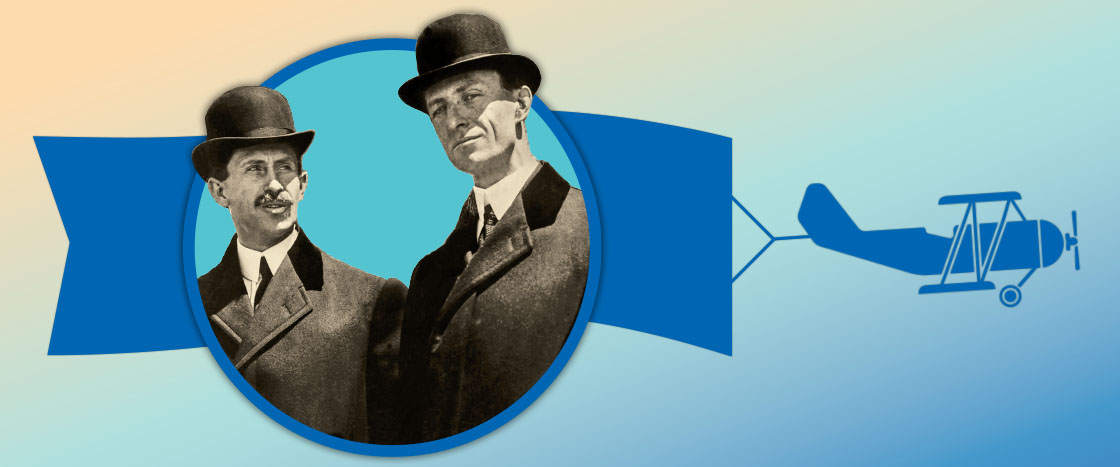
Through the 1800s, people used hot-air balloons and gliders (aircraft with no engines) to fly. But in 1899, two brothers from Ohio—Orville and Wilbur Wright—set out to build a plane that could take off, fly, and land using an engine. After years of experiments, the brothers finally took their first successful flight on December 17, 1903. It lasted only 12 seconds!
Back to Teacher View
Student View
Bettmann Archive/Getty Images (Wright Brothers); Vintage Images/Alamy Stock Photo (Car); Shutterstock.com (Banner)
High-Flying History
You’re going to read a play about an amazing airplane pilot from long ago. Here are four facts you should know first.

By Alessandra Potenza
From the February 2026 Issue

1. The first engine-powered plane was invented in 1903.
Bettmann Archive/Getty Images
The Wright brothers’ plane took off in 1903.
Inset: This is Orville (left) and Wilbur Wright.
2. In the early 1900s, most people didn’t travel in airplanes
Vintage Images/Alamy Stock Photo
What traveling by car looked like in 1912
Even after airplanes were invented, most people never flew in a plane. Flying was uncomfortable—and dangerous! Early planes didn’t have roofs or even brakes. People usually took boats, trains, horses, and cars to get around instead.
3. Air shows soon became popular
Agence Roger Viollet/The Granger Collection
A crowd watches a plane fly at an air show.
In the 1920s, huge crowds showed up at air shows called flying circuses. They would pay for a ticket, go to a field, and look up at the sky. Pilots nicknamed barnstormers would fly their planes and perform dangerous tricks.
4. Some pilots became famous.
Rue des Archives/The Granger Collection (Tennis); Science History Images/Alamy Stock Photo (Bessie Coleman)
These pilots are pretending to play tennis on a plane!
Inset: Bessie Coleman
Barnstormers wowed viewers. Some stood on the plane’s wings while flying. Others hung from their planes in midair! These brave pilots were famous—like today’s movie stars! One of these pilots was named Bessie Coleman. Ready to learn more about her?
Read the play “Dare to Dream.”
This article was originally published in the February 2026 issue.
Audio
()
Activities
(2)
Skills Activities
Answer Key
(1)
Audio
()
Activities
(2)
Download All Activities
Skills Activities
Answer Key
(1)

Text-to-Speech